



Automotive painting workshops are undergoing a quiet but decisive transformation — shifting from traditional spray booths toward true clean room sandwich panel-based environments. As OEMs and Tier-1 suppliers raise quality benchmarks — especially for EV body panels, high-gloss trims, and autonomous vehicle sensor housings — airborne particulates no longer just affect appearance; they compromise adhesion, coating uniformity, and long-term corrosion resistance. This evolution isn’t about adding filters to old rooms. It’s about rethinking the envelope: walls, ceilings, and joints as integrated contamination-control systems.
Leading facilities now specify cleanroom wall systems with seamless, non-shedding surfaces and zero-profile fastening — eliminating dust traps behind base trim or above ceiling grids. Unlike legacy drywall or insulated metal panels, modern cleanroom wall panel solutions offer factory-applied antimicrobial coatings, controlled thermal expansion, and rapid on-site assembly. The same rigor extends upward: cleanroom ceiling panel systems now integrate lighting, FFUs, and fire-rated access hatches into one flush-mounted plane — reducing maintenance downtime and airflow turbulence. For engineering teams evaluating vendors, compatibility with ISO Class 7–8 painting zones (and future scalability to Class 6) is no longer optional — it’s specified in the RFP.
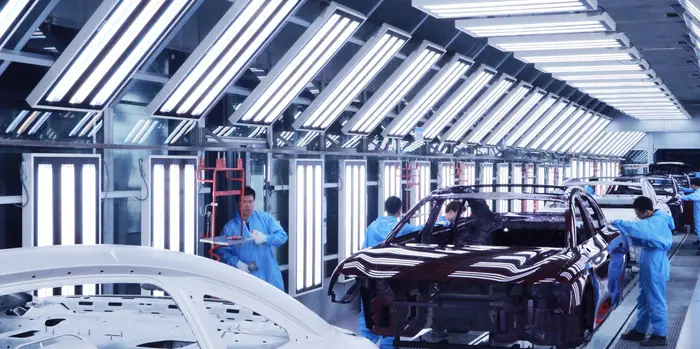
Speed, predictability, and lifecycle cost are driving adoption of modular clean room panels across new greenfield lines and brownfield retrofits. Unlike site-built cleanrooms — which often suffer from schedule slippage, material waste, and inconsistent surface finishes — pre-engineered panels arrive fully tested, labeled, and ready for bolt-together assembly. A recent project in Germany cut cleanroom enclosure time by 65% versus conventional methods, while achieving tighter dimensional tolerances (<±1.5 mm) critical for robotic spray path consistency.
For procurement and engineering managers, the choice of cleanroom manufacturer directly impacts commissioning success. Top-tier partners provide not just panels, but full system integration support: structural load calculations, static pressure modeling, and validation-ready documentation (including particle count mapping protocols aligned with ISO 14644-1). Crucially, they treat the wall-ceiling-floor junction not as an afterthought, but as a sealed continuity — using gasketed interlocks and continuous silicone-free sealing that meets automotive VOC and outgassing standards (e.g., VDA 278).